Mechanics
16 experimentsProjectiles, pendulums, collisions, springs, levers and chaos.
Free · No install · Works offline
Build, run and measure real physics. Drop a pendulum, fire a cannon, trace laser beams through a prism or watch a gas obey Maxwell–Boltzmann — with live graphs and the theory one tap away.
Every object obeys the same 2D engine — rigid bodies, joints, fields, rays, fluids and particles all interact on the same board.
Projectiles, pendulums, collisions, springs, levers and chaos.
Ripple tanks, interference, diffraction, Doppler and resonance.
Field lines, Coulomb’s law, Lorentz force and circuits.
Ray tracing with mirrors, lenses, prisms, fibres and rainbows.
Kinetic theory, Maxwell–Boltzmann, heat conduction.
Buoyancy, hydrostatic pressure and a real-time wind tunnel.
Orbits, Kepler’s laws, escape velocity and binary stars.
Photoelectric effect, half-life, blackbody, relativity.
Each experiment opens with the theory, what to observe and suggestions to try. Change any value and see what happens.
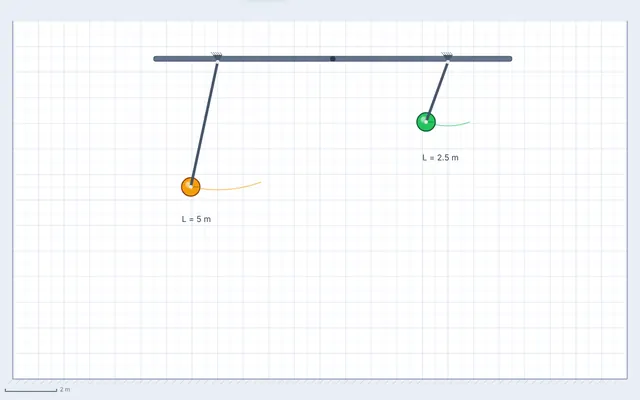 Mechanics
The period depends only on the length.
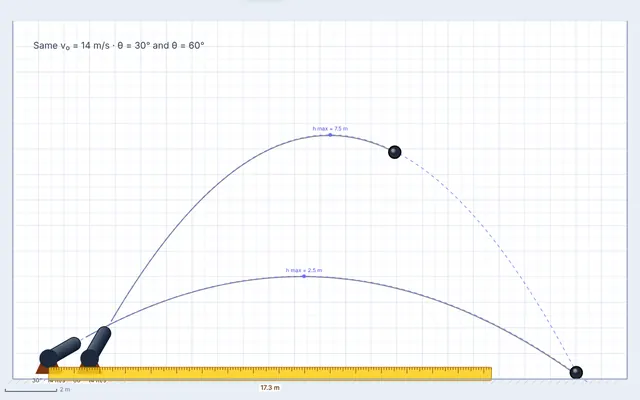 Mechanics
30° and 60°: same range.
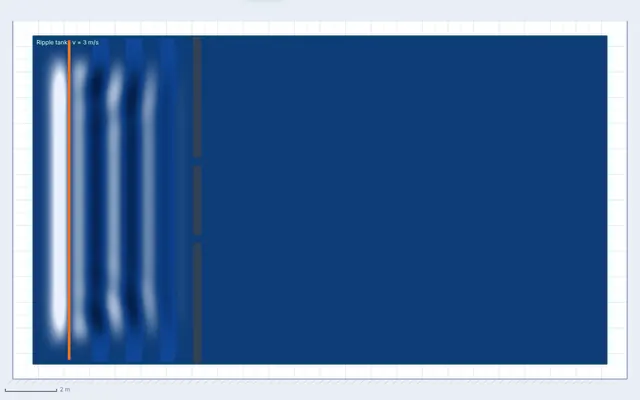 Waves & Sound
Plane waves through two slits.
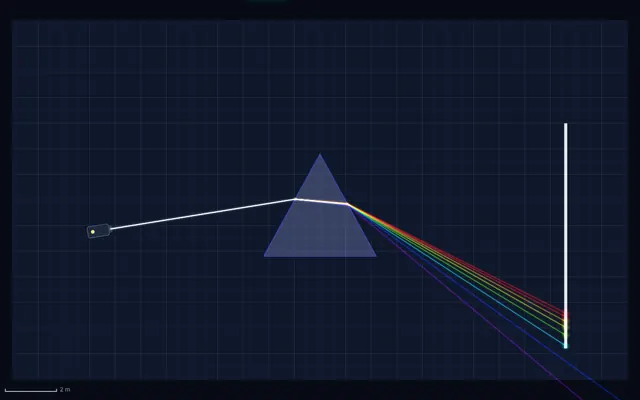 Optics
White light becomes a rainbow (Newton).
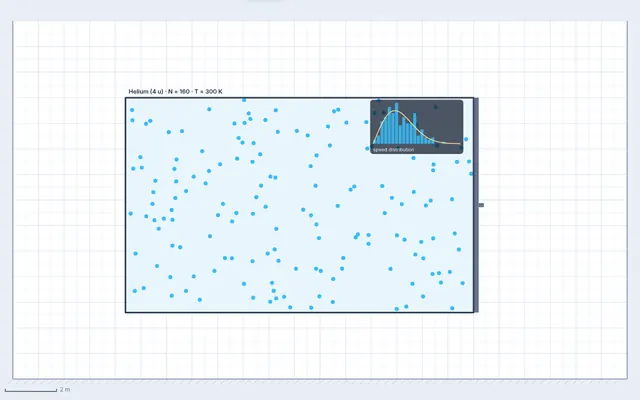 Thermodynamics
Pressure as molecules hitting the walls.
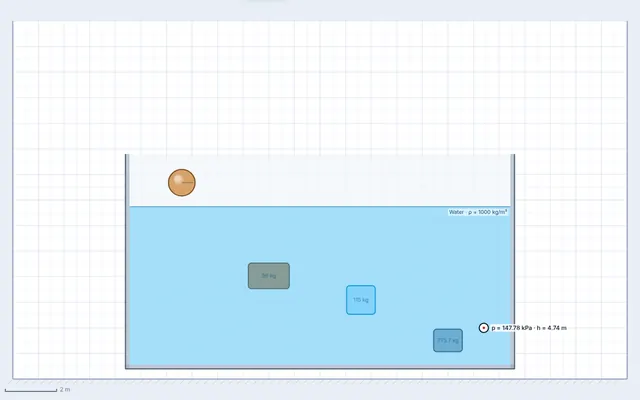 Fluids
Sink or float? It depends on density.
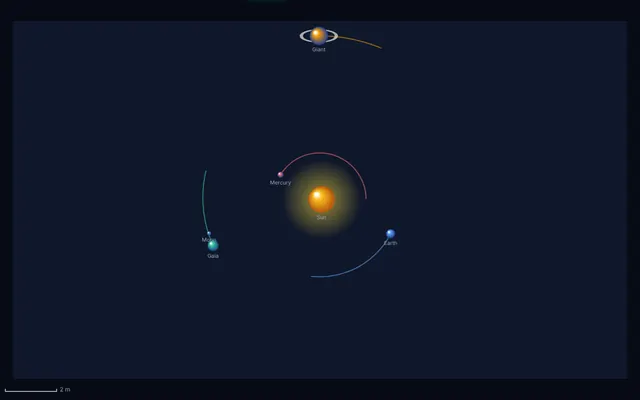 Gravitation
Orbits, periods and a moon.
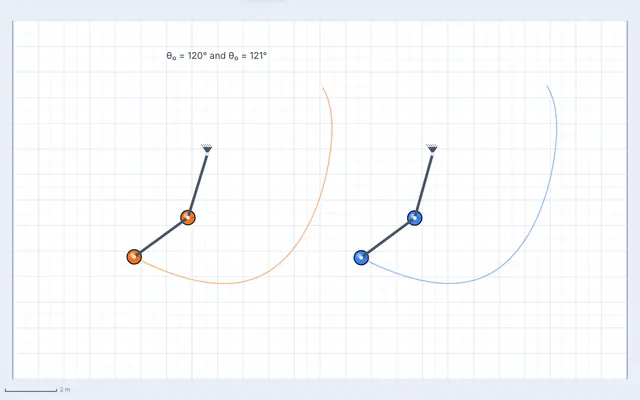 Mechanics
Two almost identical starts, completely different futures.
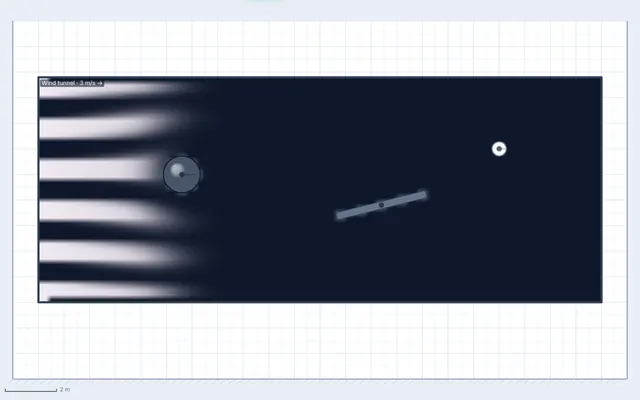 Fluids
Airflow around a cylinder and a wing-like plate.
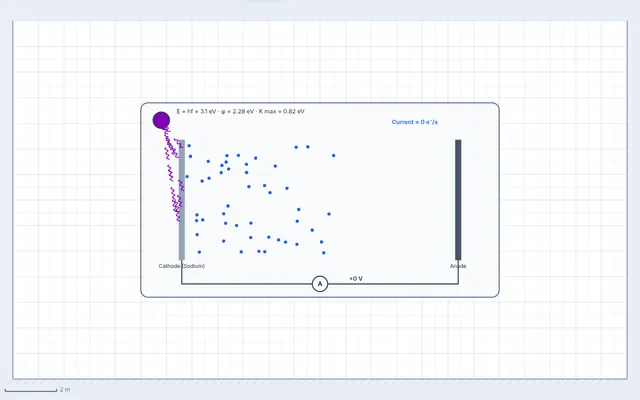 Modern Physics
Einstein and light made of photons.
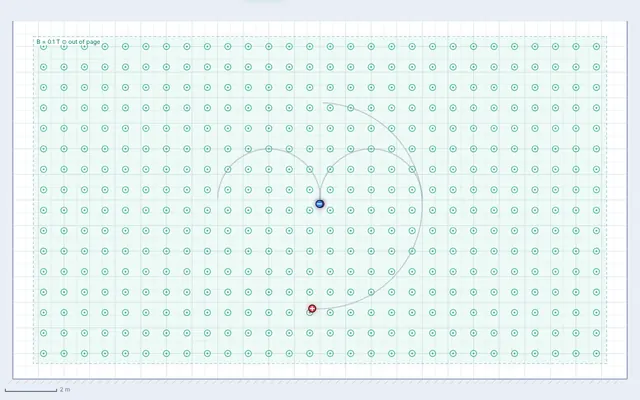 Electromagnetism
Lorentz force and circular motion.
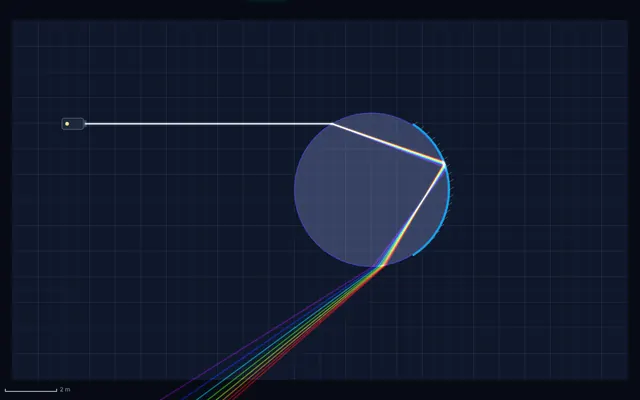 Optics
Refraction, internal reflection and dispersion.
Position, velocity, energy and more, plotted while it runs. Export to CSV for your spreadsheet.
Install it as an app on phones, tablets and computers. After the first visit everything runs without internet — and it checks for updates when you open it.
Every simulation and extension runs 100% in your browser. Your projects stay on your device unless you choose to save them to your Google account.
Create new objects, forces and experiments in plain JavaScript. Official extensions add circuits, photogates, blackbody radiation and resonance.
Sign in with Google to keep your projects in sync across devices. Optional — the lab works fully without an account.
Designed for touch and mouse: bottom sheets on phones, side panels on desktops, keyboard shortcuts for power users.
The engine integrates at 240 steps per second. Measured results from the built-in experiments match textbook predictions:
| Experiment | Simulated | Theory |
|---|---|---|
| Simple pendulum period (L = 5 m) | 4.52 s | 4.49 s |
| Mass–spring period (m = 2 kg, k = 40 N/m) | 1.403 s | 1.405 s |
| Free-fall acceleration | 9.80 m/s² | 9.80 m/s² |
| Block sliding on a 30° ramp (μ = 0.1) | 4.051 m/s² | 4.051 m/s² |
| Submerged fraction of wood in water | 0.611 | 0.600 |
| Circular orbit period | 8.10 s | 8.14 s |
Every experiment has its own address: send /app#exp=pendulo and students land right in it.
Clean themes for projectors and whiteboards, big readable labels and a presenter-friendly play button.
Students measure with rulers, photogates and live graphs, then export CSV for analysis.
The whole interface and every explanation in English, Portuguese and Spanish.
Yes. The lab and all experiments are free to use in the browser, with no installation. Some experiments may be marked Premium by the administrator in the future; the free collection keeps working without an account.
Yes. Open it once and install it as an app (or just keep it open): every experiment is stored on your device and runs offline. When you are online, the app checks for updates each time it opens.
All simulations and extensions run 100% inside your browser. No physics code runs on a server, and extensions you install never leave your device.
Any modern browser on Windows, macOS, Linux, ChromeOS, Android and iOS/iPadOS — computers, tablets and phones, with mouse, pen or touch.
Yes. Build scenes with the tools and save them as files or in your Google account, or write extensions in JavaScript to add new objects and forces.
Mechanics, waves and sound, electromagnetism, geometric optics, thermodynamics and kinetic theory, fluids, gravitation and orbits, and modern physics (photoelectric effect, radioactive decay, blackbody radiation and special relativity).
No account, no download, no limits on curiosity.
Open the lab